
Dental Implants
"You Don't Have Enough Bone for Implants" — Is That Still True?
By Dr. Mahvash Emami, DDS · 5 min read · Updated August 5, 2026
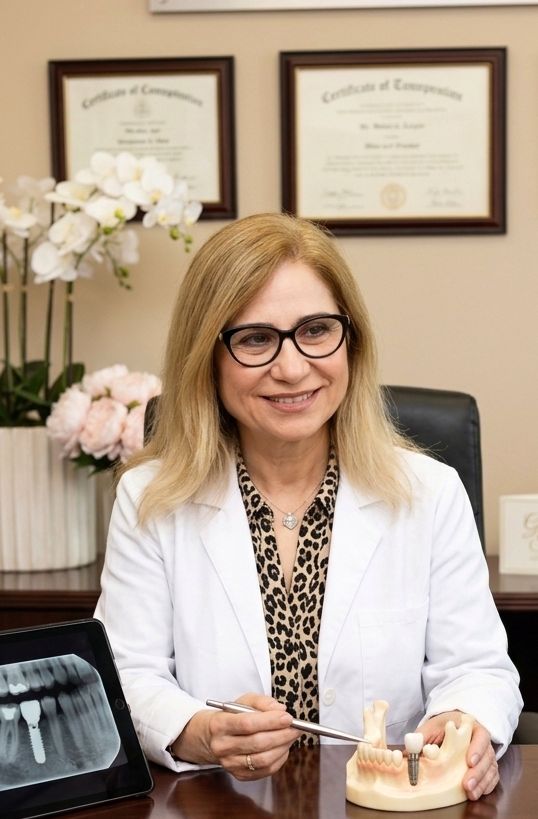
The direct answer: "not enough bone" is often a solvable problem, not a permanent verdict — and if you were told this more than a few years ago, the answer may simply be out of date. Bone grafting, sinus lifts, angled placement, and 3D planning have moved a great many patients from "impossible" to "straightforward."
Why the bone disappeared
Jawbone exists to hold teeth. Remove the tooth and the body, efficient as ever, gradually reclaims the bone that supported it — fastest in the first year, then slowly onward. It's also why a long-worn denture eventually stops fitting: the ridge underneath keeps shrinking.
What can be done about it
- Bone grafting rebuilds width or height so an implant has something to integrate with.
- Sinus lift creates room in the upper back jaw, where the sinus often sits low over missing molars.
- Angled placement reaches denser bone without grafting at all — the principle behind All-on-4.
- 3D-guided planning finds usable bone a flat X-ray simply cannot show. Some "no" verdicts were really limits of old imaging.
Get the verdict re-examined
If you were turned down for implants — especially before 3D imaging was routine — the reasonable move is a fresh evaluation rather than accepting an aging conclusion. A consultation at Sunland Dental Care includes 3D imaging and an honest read: whether you're a candidate now, what grafting (if any) would be required, and what it would cost, in writing.
And the honest flip side: sometimes the answer really is no, or the reconstruction is more than a patient wants to undertake. In that case a well-made denture or implant-supported denture is a genuinely good outcome, not a consolation prize.
Related questions
- What is a bone graft, exactly?
- Grafting adds bone material to a site that has thinned, giving an implant something solid to integrate with. It's a routine, well-established procedure, and the graft is gradually replaced by your own bone as it heals.
- Does bone grafting hurt?
- Most patients describe it as comparable to an extraction — sore for a few days, managed with over-the-counter medication. It's usually done under local anesthesia.
- How long after grafting can the implant go in?
- It depends on the size of the graft. Small sites are sometimes grafted and implanted in the same visit; larger reconstructions may need several months of healing first. 3D imaging answers this for your specific case.
Talk to a dentist who'll give it to you straight
Dr. Emami personally reviews every new-patient consultation. Call (818) 353-5520 — English, Español, فارسی.